
When Did Instant Pasta First Appear? A Comprehensive History
Share Box

Key Takeaways:

- Instant pasta as a fully cooked, dried, and reconstituted product was invented on August 25, 1958 by Momofuku Ando of Nissin Foods in Japan
- Global consumption reached approximately 103 billion servings annually by 2018, with China accounting for 40 billion packages (39% of world consumption)
- The invention emerged from post-WWII food shortages in Japan and Ando’s year-long development process inspired by his wife’s tempura cooking technique
- Cup Noodles, introduced in 1971, revolutionized instant food packaging by combining container, preparation vessel, and eating bowl
- The quick-cooking pasta segment (3-5 minute cook time) represents a distinct category from flash-fried instant noodles
On a winter evening in 1957, Taiwanese-born food scientist Momofuku Ando watched dozens of people stand in line—some for up to 30 meters—in front of a makeshift ramen stall, shivering in the cold just for a single bowl of noodles. That image would spark a culinary revolution. Less than a year later, on August 25, 1958, Ando’s company Nissin Foods launched Chikin Ramen, the world’s first true instant pasta product, forever changing how humanity thinks about convenience food. This invention didn’t merely create a new product; it established an entirely new food category that would eventually reach 103 billion servings consumed globally each year according to the World Instant Noodles Association.
The Origins: Post-War Japan and the Quest for Food Security
To understand when instant pasta emerged, we must first examine the historical context that made its invention possible. Following World War II, Japan faced severe food shortages, with rice scarcity forcing many citizens to survive on imperfectgrains and improvised meals. According to Nissin Foods’ official company history, Ando—then a salt merchant—became determined to create a food product that could provide delicious nutrition anywhere, anytime. His philosophical conviction, often quoted in food industry publications, was that “peace will come to the world when there is enough food.”
Before Ando’s breakthrough, a crucial technological foundation had already been laid. In 1953, Japanese inventor Yoshio Murata developed the process of mechanically curving noodles into wavy shapes. This innovation, as documented in the Journal of Ethnic Foods research paper “Noodles, traditionally and today” (2016), made it possible to curl noodles dozens of times faster, enabling mass production. The wavy shape presented multiple advantages: more noodles could fit into smaller packages, they were less likely to stick together during cooking, they cooked more evenly, and they were easier to transport and store.
The 1958 Breakthrough: Flash-Frying Technology
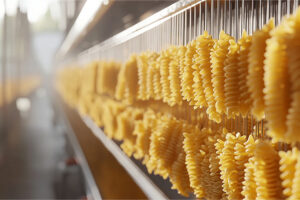
Ando’s genius lay not in creating a single innovation but in developing an entire production methodology. After approximately one year of experimentation—reportedly inspired by watching his wife Masako fry tempura and observing how oil instantly removed water from food—he developed the flash-frying technique that became the cornerstone of instant pasta production. This process involved steaming noodles, seasoning them, and then dehydrating them in hot oil, which created a porous internal structure that allowed rapid rehydration when boiling water was added.
The resulting product was remarkable: each noodle block was pre-seasoned and sold for ¥35. Most impressively, consumers could prepare a complete bowl of noodles in just two minutes by simply adding boiling water. According to historical records from Nissin Foods, Chikin Ramen was initially considered a luxury item because Japanese grocery stores typically sold fresh noodles for only one-sixth of that price. However, the product’s convenience and consistent quality eventually won over consumers, especially after Mitsubishi Corporation began promoting it widely.
The flash-frying method (known as 油炸工艺 in Chinese and recognized globally as the standard instant noodle production technique) addressed several fundamental challenges that had prevented earlier attempts at instant pasta. Traditional dried pasta could take 15-20 minutes to cook and lacked the built-in seasoning that made instant products so appealing. By contrast, Ando’s creation was simultaneously the noodle, the broth, and the meal—instantly accessible with minimal preparation.
Global Expansion: The 1960s and 1970s
The 1960s witnessed the rapid internationalization of instant pasta. In 1964, the Japan Instant Food Manufacturers Association was established to set quality standards and promote the industry. The same year marked Japan’s entry into the dehydration technology export market, as Japanese manufacturers began licensing their production methods to companies worldwide. By the mid-1960s, annual Japanese production exceeded 25 billion servings, demonstrating the explosive growth potential of this new food category.
A pivotal moment occurred in 1966 when Ando visited the United States to promote Chikin Ramen. According to Nissin Foods’ official accounts, he observed American consumers dividing ramen blocks and placing them in paper cups with boiling water—a behavior that inspired his next revolutionary concept. The insight was elegantly simple: why not design the packaging itself as the cooking and eating vessel?
This observation led directly to the introduction of Cup Noodles in 1971, the world’s first cup-type instant noodle product. Developed by Nissin with design input from American engineer Ron R. Matteson, Cup Noodles combined three functions previously served by separate items: packaging, cooking vessel, and dining bowl. The original product launched in the United States with three flavors—beef, chicken, and shrimp—with pork flavor added in 1976. This innovation proved particularly significant for Western markets where bowls were not traditionally common kitchen items.
Market Data: A Global Phenomenon
The instant pasta industry has grown into one of the most significant segments of the global food market. According to the World Instant Noodles Association’s 2018 statistics, worldwide consumption reached approximately 103 billion servings annually. The geographic distribution of this consumption reveals fascinating patterns:
| Country/Region | Annual Consumption | Market Share |
|---|---|---|
| China | 40 billion packages | 39% |
| Indonesia | 12 billion | 12% |
| India | 6 billion | 6% |
| Japan | 5.7 billion | 5.5% |
| Vietnam | 5.2 billion | 5% |
When examining per-capita consumption, the data tells a different story. South Korea leads with 74.6 servings per person annually, followed by Vietnam at 53.9 servings and Nepal at 53 servings per capita. This contrast between absolute volume and per-capita consumption reflects both population size and cultural integration of instant pasta into daily diets.
Comparing Production Methods: Oil-Fried vs. Air-Dried
Not all instant pasta products are created equal, and understanding the distinction between production methods helps consumers and industry professionals make informed choices. The original flash-frying technique developed by Ando remains the dominant method in Asian markets, where it produces the characteristic curly, porous noodle block. This process involves cooking the noodles briefly in oil at temperatures typically between 140-160°C, which gelatinizes the starches and creates the instant-rehydrating structure.
In contrast, Western manufacturers increasingly favor hot-air drying (also called air-dried or oven-dried) methods for instant pasta products. This technique, which emerged as an alternative in the late 1970s, produces a denser noodle with a different texture profile. According to food science research published in the Journal of Food Engineering, air-dried products typically have a rehydration time of 4-5 minutes compared to 2-3 minutes for oil-fried versions, but some consumers prefer their firmer bite and perceived “cleaner” ingredient profile.
| Production Method | Processing Time | Rehydration Time | Texture | Popular Regions |
|---|---|---|---|---|
| Flash-Frying | 15-20 seconds | 2-3 minutes | Soft, porous | East Asia, Southeast Asia |
| Hot-Air Drying | 30-45 minutes | 4-5 minutes | Firm, dense | Europe, North America |
| Vacuum Drying | 20-30 minutes | 3-4 minutes | Medium density | Specialty products |
The choice between methods involves trade-offs beyond just cooking time. Flash-fried products generally contain 15-20% oil by weight, contributing to both flavor and caloric content, while air-dried products have lower fat content but may require additional seasoning to achieve equivalent taste profiles.
The 21st Century: Innovation Continues
The instant pasta industry has not remained static since Ando’s original invention. In 2005, Space Ram—a specially developed version of Cup Noodles—became the first instant noodles consumed in space, aboard the Space Shuttle Discovery, satisfying astronaut Soichi Noguchi’s craving for authentic ramen during his six-month mission aboard the International Space Station.
Contemporary manufacturers continue pushing boundaries with extrusion technology advances, which shape pasta through forced passage through dies, enabling increasingly diverse formats beyond traditional strands. Modern products now incorporate kansui (alkaline mineral water containing sodium carbonate and potassium carbonate) for improved texture and color, and some manufacturers have introduced reduced-sodium, added-fiber, and collagen-enriched varieties to address health-conscious consumers.
The global instant pasta market continues evolving in response to changing consumer preferences. In Japan, where the category was invented, competition has intensified among established players like Nissin and newcomer regional brands, driving continuous product innovation. Meanwhile, in emerging markets across Africa and South America, instant pasta consumption is growing rapidly as urbanization and changing lifestyles increase demand for convenient meal solutions.
A Revolutionary Timeline
To directly answer the question of when instant pasta first appeared: the world’s first commercially successful instant pasta product—Chikin Ramen—debuted on August 25, 1958, at Osaka’s Mitsukoshi department store. This date marks not merely the introduction of a new product but the birth of an entirely new food category that would transform global eating habits.
The evolution from that single product to today’s 103 billion annual servings represents one of the most successful food industry innovations in history. Momofuku Ando’s vision—sparked by observing people waiting in cold lines for ramen and refined through his wife’s tempura-frying technique—created an industry that now spans six continents and serves consumers from Tokyo to Lagos. His 2006 recognition by Time Magazine as one of “66 Asian Heroes” acknowledges what millions of consumers already know: instant pasta, born from the intersection of technology, necessity, and culinary creativity, has become an enduring symbol of modern food culture.
As we look to the future, instant pasta continues adapting to new consumer demands while maintaining the core principles of convenience, consistency, and culinary satisfaction that have made it a staple in kitchens worldwide for over six decades. Whether consumed as a quick meal in a corporate office in Shanghai, a late-night snack in São Paulo, or even a gourmet experiment at 400 kilometers above Earth, instant pasta remains a testament to human innovation in the service of one fundamental need: feeding ourselves, simply and deliciously.



 English
  Russian
  Arabic