
No Cook Pasta Technology: Advanced Processing Methods Redefining Instant Pasta
Share Box
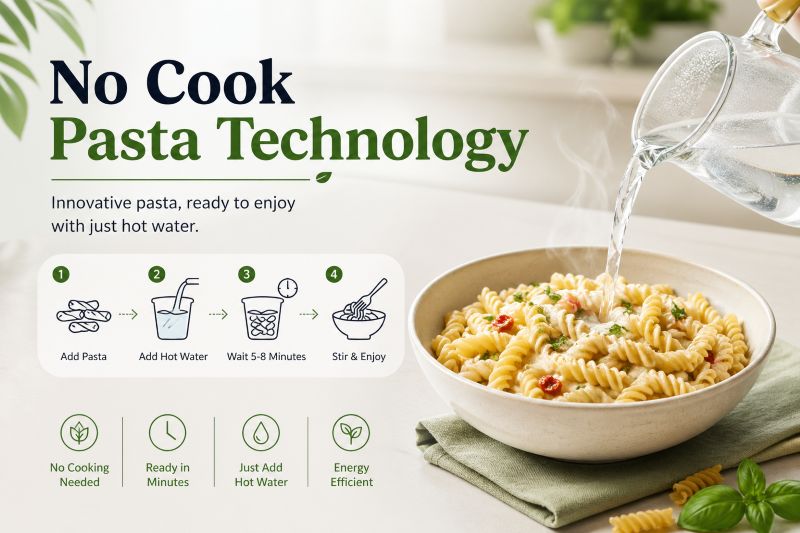

The global shift toward convenience-driven consumption has accelerated innovation in food processing technologies. Among these developments, no cook pasta technology has emerged as a highly specialized solution that significantly reduces or eliminates the need for traditional thermal cooking.
Unlike conventional dried pasta, which relies on extended boiling to achieve starch gelatinization and palatable texture, no cook pasta is engineered during manufacturing to enable rapid hydration or immediate consumption. This transformation is not merely a product innovation—it represents a convergence of food science, material engineering, and process optimization.
Understanding the mechanisms behind no cook pasta technology provides insight into how modern food systems are adapting to evolving consumer demands for efficiency, portability, and consistency.
Table of Contents
The Scientific Basis of No Cook Pasta Technology
At its core, no cook pasta technology is built upon the manipulation of starch functionality and protein matrix structure. Traditional pasta is composed primarily of semolina flour, where starch granules are embedded within a gluten network. In its raw or dried state, this structure is compact and requires prolonged heating to become digestible and soft.
No cook pasta alters this structure through controlled processing, enabling:
- Partial or full starch gelatinization during manufacturing
- Disruption and reformation of the protein-starch matrix
- Increased porosity and capillary pathways for water absorption
These structural modifications allow water to penetrate the pasta rapidly, eliminating the need for extended cooking.
Key Processing Stages in No Cook Pasta Production
The production of no cook pasta involves multiple tightly controlled stages, each contributing to the final functional properties of the product.
Raw Material Selection and Formulation
The process begins with the selection of wheat varieties and flour types with specific protein and starch characteristics. In some formulations, additional ingredients may be incorporated to enhance performance:
- Modified starches to improve hydration kinetics
- Plant proteins to reinforce structure
- Hydrocolloids to stabilize texture during rehydration
Formulation plays a critical role in determining the balance between mechanical strength and rapid rehydration capability.
Extrusion and Structural Engineering
Extrusion is a central step in pasta manufacturing, but in no cook pasta technology, it is optimized to create microstructural uniformity and controlled density.
Process variables include:
- ताप(temperature)profile within the extruder
- Moisture content
- Screw speed and الضغط (pressure)
These parameters influence starch transformation and protein alignment, directly affecting the final texture.
Controlled Pre-Cooking (Thermal Treatment)
One of the defining steps in no cook pasta technology is pre-cooking, where the pasta undergoes partial or near-complete thermal treatment.
During this stage:
- Starch granules swell and gelatinize
- Protein networks denature and reorganize
- Internal moisture distribution becomes more uniform
The degree of pre-cooking must be precisely calibrated—overprocessing can lead to structural collapse, while underprocessing reduces rehydration efficiency.
Advanced Drying and Dehydration
Drying is not simply about removing moisture; it is a critical step in stabilizing the modified structure. Advanced drying technologies are used, including:
- Multi-stage hot air drying
- Vacuum drying
- Freeze drying (in specialized applications)
The objective is to maintain structural integrity while preserving rehydration capacity, ensuring that the pasta can quickly absorb water without becoming mushy.
Microstructure Optimization for Rapid Rehydration
The final product is engineered with a micro-porous internal structure, which facilitates rapid water diffusion. This is achieved through precise control of:
- Pore size distribution
- Surface area
- Internal channel formation
These characteristics directly influence hydration time, texture recovery, and mouthfeel.
Hydration Kinetics and Functional Performance
One of the most critical performance indicators of no cook pasta technology is hydration kinetics—the rate and uniformity at which water is absorbed.
Compared to traditional pasta, no cook pasta exhibits:
- Faster water uptake due to increased porosity
- Reduced diffusion resistance
- More uniform moisture distribution
This results in preparation times ranging from instant to under 3 minutes, depending on product design.
However, achieving optimal hydration requires balancing several factors:
- Water temperature
- Pasta thickness and geometry
- Degree of pre-gelatinization
Texture Engineering and Sensory Attributes

A major technical challenge in no cook pasta technology is replicating the al dente texture associated with traditional pasta.
Texture is influenced by:
- Protein network elasticity
- Degree of starch retrogradation
- Moisture content after rehydration
Manufacturers use various strategies to improve sensory quality:
- Incorporation of protein blends to enhance firmness
- Controlled retrogradation to stabilize structure
- Surface treatments to improve mouthfeel
While early versions of instant pasta often lacked desirable texture, modern advancements have significantly narrowed the gap.
Comparison with Traditional Pasta Processing
| Parameter | No Cook Pasta Technology | Traditional Pasta |
|---|---|---|
| Starch State | Pre-gelatinized | Native (raw) |
| Cooking Requirement | None or minimal | Full boiling required |
| Hydration Time | Seconds to minutes | Several minutes |
| Structural Density | Porous | Dense |
| Processing Complexity | High | Moderate |
This comparison highlights how no cook pasta technology shifts complexity from the kitchen to the manufacturing stage.
Industrial Applications and Market Integration
No cook pasta technology has become increasingly important across multiple sectors of the food industry:
- Ready-to-eat meal systems requiring minimal preparation
- Instant pasta cups designed for hot water activation
- Military and emergency rations where cooking resources are limited
- Travel and outdoor food products emphasizing portability
Its adaptability makes it a key component in modern food supply chains.
Nutritional Considerations and Optimization
Processing can influence the nutritional profile of pasta. Key considerations include:
- Potential changes in starch digestibility
- Effects on glycemic response
- Retention of micronutrients during thermal treatment
Manufacturers are increasingly developing formulations that incorporate:
- Whole grain ingredients
- High-protein blends
- Reduced sodium seasoning systems
These improvements align with consumer demand for both convenience and health-conscious options.
Challenges in No Cook Pasta Technology
Despite its advantages, several technical challenges remain:
- Maintaining structural integrity during storage
- Preventing over-softening during hydration
- Achieving consistent sensory quality across batches
- Balancing shelf life with rehydration performance
Ongoing research focuses on improving process control and material optimization to address these issues.
Future Directions in No Cook Pasta Innovation
The future of no cook pasta technology is likely to involve integration with emerging trends in food science:
- Smart processing systems using AI-driven quality control
- Sustainable production methods with reduced energy consumption
- Functional formulations targeting specific dietary needs
- Enhanced flavor delivery systems for improved consumer experience
As these innovations develop, no cook pasta is expected to play a central role in next-generation convenience foods.
Conclusion
No cook pasta technology represents a sophisticated application of food engineering principles aimed at transforming one of the world’s most traditional foods into a modern, convenience-driven solution.
By leveraging advances in starch chemistry, extrusion processing, and dehydration techniques, manufacturers have created products that significantly reduce preparation time while maintaining acceptable quality standards.
As consumer expectations continue to evolve, no cook pasta technology will remain a critical area of innovation, bridging the gap between efficiency, nutrition, and sensory satisfaction.
FAQ
What makes no cook pasta different from regular pasta?
It is pre-processed to allow rapid hydration without traditional boiling.
Is no cook pasta fully cooked during production?
It is typically partially or nearly fully pre-cooked, depending on the design.
How fast can no cook pasta be prepared?
Most products can be ready in under 3 minutes.
Does no cook pasta have the same texture as traditional pasta?
Modern technology has improved texture, but slight differences may remain.
What industries use no cook pasta technology?
It is widely used in instant meals, ready-to-eat products, and emergency food systems.



 English
  Russian
  Arabic